Showing posts with label Baloch Culture. Show all posts

Thursday, 13 March 2014

In Pictures: Sibbi Mela Balochistan 2014

Sib Mela, where tribesmen flock from all over Baluchistan, parts of Sind and Punjab with their animals. The salient features of this “Mela” are horse and cattle and cultural shows, tent pegging, camel races. Animal markets and exhibitions o handicrafts, tribal dresses and folk dances.


Monday, 16 December 2013

An erudite presentation of seven millennia of Balochistan


Karachi: It was a highly informative and revealing sojourn in the non-linear dimension as the guests were catapulted back in time seven millennia.

Dr Ute Franke from the Museum of Islamic Art in Berlin took the guests on a journey of Balochistan as it was 7,500 BC.At the residence of German Consul-General Tilo Klinner on Monday evening, Dr Franke’s lecture enlightened the gathering on the highly advanced civilisation that Balochistan was.

The event, titled ‘Balochistan Evening’ and showcasing Balochi culture and cuisine, featured the erudite lecture by Dr Franke, followed by a performance of Balochi folk music featuring noted Baloch instrumentalist Sachu Khan, who captivated the audience with his mastery over the suroz, a bowed string instrument similar to a sarangi.

The lecture was accompanied by slide presentation featuring artefacts from the millennia gone by discovered in Balochistan from tombs and digging at other points. These included items of jewellery and pottery.

Dr Franke said interest of archaeologists in Balochistan began to be aroused in the 1920s after the discovery of the Indus civilisation.She said the first discovery was the Mehrgarh civilisation, dating back around 7,500 BC, and later Khuzdar. She termed Balochistan the cradle of civilisation.

She said many of the artefacts found were traced to have been brought in from Afghanistan, which was indicative of the large trade network that existed in the region even in that “primitive” era.

Dr Franke said that it was in the third millennium that pottery and jewellery with geometric and figurative art flourished in Balochistan.She said that it was a mystery as to how such sites, connotative of an advanced civilisation, flourished in a province like Balochistan, arid as it is, with hardly any river worth its name.

She said an interesting discovery was the find of bones and skeleton of a brown bear, something that could not even be thought of in the present era.

Dr Franke also mentioned the fruits that were found in the province in prehistoric times, like figs and jojoba, and farm produce like sesame and millets. She exhibited slides of wells and dams, the latter being around 70 to 80 metres wide.

Her lecture was followed by a performance by Sachu Khan on the suroz. The tunes and the tone of the instrument were evocative of the rural and pristine component of Baloch civilisation, in quick time, oozing verve and vivacity.

Sachu Khan demonstrated complete mastery over his suroz. The instrumental performance was followed by four vocal renditions by Khadim Hussain.This was then followed by two dances, one of them being the Balochi lewa, by a quartet of four male dancers.

The dances comprised highly rhythmic and artistic movements but also incorporated a significant element of vigorous physical exercise and semi-acrobatics.Welcoming the guests earlier, CG Klinner said what had led the German government to work for the conservation of this priceless heritage was the confiscation by the Pakistan Customs of 804 genuine artefacts from the ancient civilisation that were being smuggled into a neighbouring Middle Eastern country.

Besides, he said, they were enthusiastic about Balochistan and Pakistan because they had changed the narrative.He said Pakistan had many positive aspects to it and it was his government’s endeavour to project only the positive aspects of Pakistan’s rich cultural heritage and Pakistan as such.

< The News >

Friday, 25 May 2012

Balochi Dress for Women


By: Samia Batool, Quetta

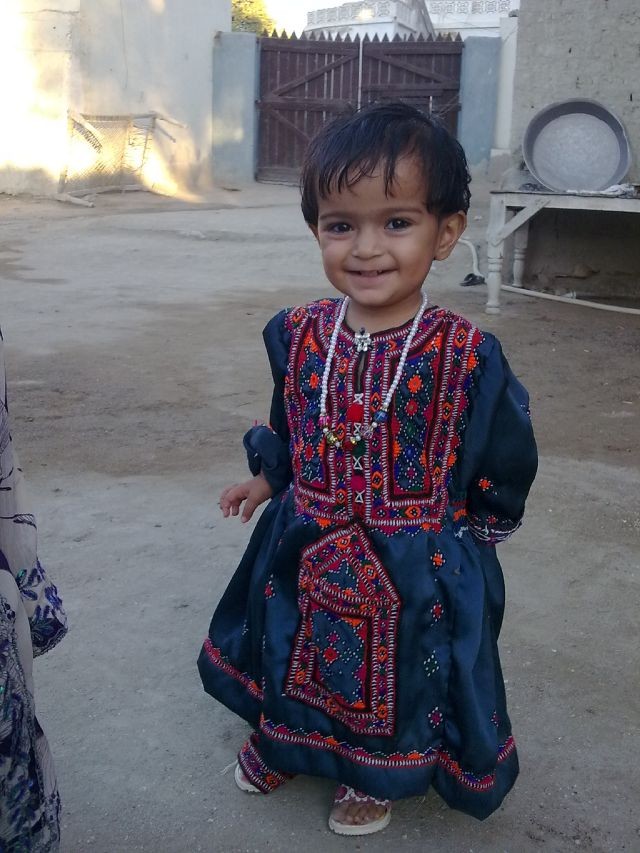
Balochi Dress for woman is one of the beautiful cultural sides of Balochistan. The Balochi Dress is attractive, in fashion, classic and very rich that a woman from any part of world can’t deny wearing it. Balochi dress is called “phashik” in Balochi language.

It has heavy embroidered sleeves and borders. It has pockets which are in triangle shape. This triangle shaped pocket is sewed with Daman and lots of beautiful embroidery is done on it too. Balochi dress is unique since the embroidery work on it leads you to unique taste of art in Baloch. The patterns, the designs of Balochi dress are unique and eye catching that you can’t find that type of embroidery work in other cultural dresses.

In making of Balochi Dress glass, multiple colored threads and a fabric is used. This fabric can be anything of your choice but usually cotton, silk and Jorchad is used. Talking of appealing colors in Balochi dress, let us tell you that red, green, black, yellow and blue are the most commonly used colors in making of Balochi dress, but as due to requirements of design, the Balochi dress can be consisted of countless colors. Their combination will definitely take one’s heart away.

Balochi dress is very dynamic since they vary area to area. Like in Balochistan if a Baloch woman wears balochi dress with out embroidered borders then she is thought to be a widow. The happily married balochi women wear balochi dress with heavy, rich and bright colored embroidery not only on border but on sleeves too. You will amazed to know that this phenomena is not observed in Balochs of Iran, there even a married woman can wear a Balochi dress with out any heavy embroidery on borders.

X-Federal Minister Zubaida Jalal in Balochi dress
Balochi dress is no doubt an apple of eye for any fashion designers since there is lot of space to make it more beautiful and up to date. Like till date Balochi dress embroidery is done in many mediums, depending on its medium of embroidery many new designs are introduced or they existed before but revealed again they are kundi, bugti and Sheeshay wala kam(the embroidery with glass).

Balochi dress as time passes changes itself .The balochi dress with pockets are preferred to be worn in sui and bugti but in Quetta, modern Baloch Girl would like to wear balochi dress without pockets.

The balochi dress is very beautiful and adorable and hence it takes lots of money and time to be prepared. Its price ranges from few hundreds to thousands. An average balochi dress takes 7 to 8 months to prepare since this is one of the unique hand-made dress.

So, if you are fond of experiencing the various cultures and their customs, then get started with balochi dress. This Historic, rich dress will take you as it part.

<Balochi Linguist>

Tuesday, 8 May 2012

The untold tales of Lyari


Lyari in the early 20th century. – File photo
Gang wars, poverty, Pakistan Peoples Party (PPP), football and, maybe, boxing are the notions usually associated with Lyari, one of Karachi’s oldest neighbourhoods. There is, however, more to Lyari than these stereotypes.
Historically, the inhabitants of Lyari were among the first settlers Karachi.
In her book “The Dual City: Karachi During the Raj,” renowned architect Yasmeen Lari writes: “By 1890 the population of Lyari had already reached 24,600.” These figures are indicative of Lyari’s high population rates even before the notion of partition emerged. Even today, the area remains among the most densely populated, with the highest ratio of inhabitants-per-square-kilometre.
Some of the most popular names to have been associated with Lyari include Hussain Shah (Olympic boxer), Umar Baloch, Ghulam Abbas and Ustaad Qasim (footballers), Waja Ghulam Muhammad Noor ud Din (educationist), Syed Sajjad Ali Shah (former Chief Justice), Waja Khair Mohammad Nadvi (scholar who translated Quran into Balochi language) and Sikandar Baloch (former Mr Pakistan in body building).
Lyari’s history, however, goes beyond these names.
Quaid-e-Azam and Lyari
In 1948, during the days of his illness, Quaid-e-Azam Muhammad Ali Jinnah was travelling near Lyari, when his car came to a sudden halt in the area. The inhabitants were quick to offer their services to the country’s founder. In those early post-partition days, Lyari was home to a sizable immigrant population, which was welcomed by the old settlers of the area despite their own financial woes.
Later that year, when Jinnah lost his life to prolonged illness, it was one of Lyari’s oldest sons Noor Mohammad Baloch, who performed his burial, as well as that of the country’s first prime minister Liaquat Ali Khan.
After Jiinah’s death, government officials got in touch with Zulekha Bibi, who was in charge of Marwari Grave Yard to prepare for the burials. Zulekha instructed Baloch and others to finalise and carry out the services.

A certificate showing appreciation for the services of Zulekha Bibi – a resident of Lyari overlooked arrangements for the burial of Quaid-e-Azam Muhammad Ali Jinnah and Liaquat Ali Khan. – Photo courtesy Ayoub Baloch
The literary Lyari
Apart from being home to sports greats, Lyari has also attracted one of the biggest names of Pakistan’s literary world. For Faiz Ahmed Faiz, Lyari was like a passion. In the early 1970s, Faiz frequented the Abdullah Haroon College, where he taught and served as principal (1972-73).
“We were very fortunate to have Faiz sahib at the college,” says Zafar Ali Zafar – a Balochi and Urdu poet from Lyari.
“He (Faiz) would travel from the Nursery area (in Karachi) to Lyari to offer his services because it was very close to his heart,” recalls Zafar.
Zafar says Faiz inspired him and his poetry. “He even selected a poem for me to recite at a Radio Pakistan mushaira (poetic symposium).”
Decades after Faiz’s death, Lyari still maintains a literary aura.
“The Abbas Ali Zehmi Academy remains an active hub for literary dialogue, with Ghani Bux and Hassan Ali Hassan among the most active poets.”
Muhammad Baig Baloch is another literary figure from Lyari. “He has written several books in Urdu, English, Sindhi and Persian in addition to translating major literary works into Balochi language.”
Lyari has also been central to the region’s politics. The Madressah Mazhar ul Uloom played a pivotal role in anti-British movements (including the Khilafat Movement) in the pre-partition era. Lyari-based Qadir Bux Rind Baloch (alias Kadu Makrani), an anti-British freedom-fighter met his death in the Chakiwara area in 1887, when he was hanged.
In the days of the martial law imposed by Ayub Khan, members of the Alliance for Restoration of Democracy (ARD) would meet at Lyari’s Kakri ground.
From Lyari to Australia
Lyari is commonly known for its passion for camel-cart racing. The area, however, was once the centre of camel trade to countries as distant as Australia.
Traders Dost Muhammad Brohi and Jorak introduced the camels of Balochistan and Afghanistan to Australia, via steam ships in the 1890s
Camel trade took Brohi, a Baloch born in 1870, to Australia in 1883, but it was his love for British girl Annie that made him settle down in the country and marry her in 1986.
Brohi, however, remained unsettled in the Australian lifestyle and after several brawls, his wife’s brothers killed Brohi in 1909.
Annie was then invited by the Brohi family to visit Karachi. Upon her arrival, Anne was murdered by Brohi’s brothers, who accused her for their brother’s death.
In 1993, Brohi and Annie’s granddaughter Jane Garnand landed in Karachi, in search of Annie’s grave, which she later found in the Clifton area.
Education on the streets
Lyari boasts a distinctive record of school systems, such as the ARM and Kiran Hasht Chowk and Baghdadi areas are, in particular, the hub of education. Here, local non-government organisations have been operating “street schools” for students of primary and secondary classes.
The educated youth of the area have launched the “Lyari Naujawan Tehrik” against the prevalence of drugs and crimes in the area. The movement came under threat from the drug mafia but also brought in other NGOs, which set up schools for informal education.
Despite the odds, street schools in Lyari offer hope to the people of Lyari, as they discourage the youth from falling prey to the gang wars.
“Financial problems are real ailment of Lyari, “according to M.Y Baloch a concerned local.
“Political parties have failed to meet our needs and even the ruling party made empty pledges, said Baloch.”
Lyari, can be called a mini-Pakistan, with colours of culture, sports, and traditions. The Lyari River was clean and a healthy habitat for fish, before the 1970s. It has now turned into a dirty stream. The sea breeze from Lyari cooled the other parts of Karachi, which has now been blocked by the Lyari Expressway.
Locals believe their miseries can be dealt with, if the government is sincere.
“The people of Lyari need love not force,” insists Zafar, as he recalls a Balochi proverb: “Hoo’n Go’n Hoo’na Shodag Nabet – you can’t wash blood with blood.
From: Dawn

Monday, 30 April 2012

A flavour of Balochistan in the capital

Express Tribune Report on Baloch culture in Lok Versa


An enclosure titled “the Balochi pavilion” was dedicated to the Balochi arts and crafts, music, dance and cuisine. At the venue, there were 50 craftspersons, 20 folk artists and musicians and four folk dance troupes each comprising 10 to 15 dancers and performers.

Among other artisans, Kaneez Fatima, 42, displayed her embroidery. She learnt the decades-old craft from her mother and has been practicing it for about 30 years now. This was her fifteenth year at the festival, previously she has won a number of prizes and accolades for her work.

The dance troupes entertained the audience with their distinctive attire and riveting dance moves like Pushtun Athan, Leva (camel dance), Balochi Chaap party, Noshi and Kharan. With their synchronised moves, they entertained the onlookers tirelessly.

Meanwhile, scores of people were seen devouring Sajji, a speciality of the mountainous region.
“One can see the glimpses of every corner of Pakistan in the lush green surroundings of Shakarparian hills. This enhances the beauty and landscape of the federal capital,” said Rashid Amin, a visitor.

Saudi deputy FM visits the festival
Deputy Foreign Minister of Kingdom of Saudi Arabia Prince Abdul Aziz Bin Abdullah Bin Abdul Aziz, accompanied by his entourage also visited Lok Virsa.

On arrival, the distinguished delegate was given a very warm welcome by a group folk dancers and dholis (drummers) attired in traditional beautiful costumes.

Officials from the Ministry of National Heritage and Integration, including the Federal Minister Samina Khalid Ghurki, received the delegates, who were then briefed about the festival by Lok Virsa Executive Director Khalid Javaid.

The dignitary was taken around the various creative displays at the first ethnological museum of Pakistan, popularly known as Heritage Museum, portraying living folk culture and lifestyles of the people represening each and every corner of the country.

The delegate was particularly impressed by the “Hall of Sufis and Shrines” where services of the sufis and scholars have been creatively explained through a dioramic form. The visit ended with a short live musical performance by folk artists.

Meanwhile on Wednesday, Goodwill Ambassador for Women Empowerment Fiza Batool Gilani also visited the festival. Lok Virsa is doing a great service to the nation by safeguarding Pakistan’s indigenous folk culture and supporting traditional practitioners, she said. She also announced six awards of Rs10,000 each for female artisans.

<Express Tribune>

Friday, 27 April 2012

Balochi & Birahvi Singer Murad Parkoi Passed Away

Famous Balochi & Birahvi Singer Murad Parkoi Passed away in Bolan Medical Hospital, Quetta.

Vsh Tv Report:


Preforming in PTV Bolan:


Tuesday, 17 April 2012

Rich Baloch culture, a feast for Lok Mela visitors


Baloch Folk Dancers at Lok Mela

Islamabad—The rich culture and traditions of Balochistan displayed here at the ongoing ‘Lok Mela’ serve as an eye-catching attraction for the visitors with the arts and crafts of the province. The Balochi pavilion set up by the Balochistan Culture Department in collaboration with Lok Virsa showcases the indigenous folk culture in a creative and interactive manner.

It presents the richness of Balochi culture, arts, crafts, folk music, rituals, traditions, cuisine and folk entertainment while the stalls are setup with Balochi architectural touch of gates and arches. The Balochi contingent includes 50 craftspeople, 20 folk artists and musicians and four folk dance groups each comprising 10 to 15 dancers/performers. Master artisans are Kaneez Fatima, Malukan Bibi, Aziz Fatima, Natasha, Hazar Naz, Umeeda Bibi, Husna Bibi, Sajida Khan, Saba, Marzia Khanum, Kubra, Rukhdia and Rukhsana Bibi in Balochi embroidery, Muhammad Iqbal and Manzoor Hussain in carpet weaving, Muhammad Siddique and Muhammad Akram in Khaddi (handloom) weaving, Miral, Dilshad, Tariq Mehmood and Abdul Khaliq in leather work, Malai in needle work, Muhammad Hassan in leather embroidery, Rozi Khan in Balochi chappal (shoe) making and others.


Among them, female craftswoman Kaneez Fatima is a 42-year-old artisan of Balochi embroidery. Being an educated artisan, she has carried on this centuries’ old tradition from her mother and devoted 30 years of her life to this art. Kaneez stands out not only for her excellence but also in her tireless propagation of this ancient art by imparting it to the future generations.

Balochi dance group are Pushtoon Athan dance party, Leva (camel dance) party, Balochi Chaap party Noshi and Balochi Chaap party Kharan

<Pakistan Observer>

Thursday, 1 March 2012

Ceremony: Millat-e-Pakistan K Bhadur Baloch Qoum

 Millat-e-Pakistan K Bhadur Baloch Qoum cermony held in Karachi, to celeberate Baloch Culutur day.


Ajj tv Report: