Showing posts with label Hazaras/Pashtun. Show all posts

Sunday, 31 May 2015

United Baloch Army kill 22 passengers in Balochistan


QUETTA: Gunmen disguised as members of the Pakistani security forces killed at least 22 passengers on Friday night after forcing them off buses travelling from the western city of Quetta to Karachi on the southern coast, officials said.

The assault in the province of Balochistan occurred in the town of Mastung.

“Fifteen to 20 armed men in three pickup trucks and wearing security uniforms kidnapped around 35 passengers,” Sarfaraz Bugti, Balochistan’s home minister, towld Reuters. Bugti also alleged that India’s intelligence agency Research and Analysis Wing (RAW) was involved in the killings.

Mureed Baloch, a militant who identifies himself as the spokesman of United Baloch Army (UBA), which has attacked security forces in the past, claimed the bus attacks on Saturday.

In Quetta, the family members and relatives of those killed in the Mastung massacre protested outside the Governor House with victims’ bodies laid beside them. They decided to continue the protest after negotiations between them and the administration failed.

< Gulf Today >

Saturday, 25 April 2015

Afghans in Balochistan

By Farman Kakar

Afghans’ presence in Balochistan has become a deeply politicised issue between the Baloch and Pashtun nationalists

In Balochistan, the presence of Afghans is a hotly debated issue. In Quetta, I interviewed Usman Kakar, PkMAP’s senator and provincial president; Ghulam Nabi Marri, BNP-M’s general secretary Quetta district and member party’s central media committee, and Abdul Khaliq Hazara, chairman HDP, on the stances of their parties on the presence of Afghans in Balochistan and their tentative repatriation by the end of December. Lack of information on the exact number and character of Afghans’ stay informs nationalistic rhetoric as much as the craving for, or the denial of, vote bank from Afghan constituencies, all under the garb of nationalism.

Speaking critically of anti-migration feelings towards Afghans, Kakar was all accommodating to their living in Balochistan. “The 320,000 Afghans populate Afghan Watan [here Pashtun populated areas in Balochistan]. Why should it concern the Baloch? If Afghans inhabit Baloch areas, it is up to Baloch how they treat them. If Afghan kadwal (migrants) want to move, by their free will, to any part of the Pashtun Watan (homeland) either this side [Pashtun populated areas of Balochistan] or that [Afghanistan] they can; but not by coercion”, Kakar jibed.

Marri was highly critical of the protracted stay of Afghan migrants in Balochistan. “Balochistan is treated as orphanage where everyone is settled with impunity. The Afghan refugees in our province are used for nefarious purposes. We want their return to Afghanistan where the situation is now better than here. Balochistan is a province of local Baloch and Pashtuns, he remarked.”

Hazara was “in favour of the return of all Afghans including Hazaras to Afghanistan provided they are proven to be refugees as per the government authentic record.”

The exact number and status of Afghans in Balochistan are sticking points. By December 2001, more than 5 million Afghans were in Pakistan. According to UNHCR’s “Volrep and border monitoring monthly update” in March 2014, since March 2002 when UNHCR’s assisted voluntary repatriation operation began, a total of 3,807,719 Afghan refugees were repatriated to Afghanistan from Pakistan by March 31, 2014. Khyber Pakhtunkhwa accounted for 50.1 per cent of returnees followed by Balochistan 35.8 per cent, Sindh 7.4 per cent, Punjab 5.9 per cent and Islamabad 0.8 per cent.
For the federal government, the need is to evolve a consensus among all political parties, especially nationalist ones, while dealing with the issue of Afghan migrants in Balochistan.

According to UNHCR and government of Pakistan’s estimate quoted in “Census of Afghans in Pakistan 2005”, a total of 5,429,057 Afghans were repatriated to Afghanistan from 1988/89 down to March 2005. Of these some 2.4 million had returned home since March 2002. Of the 3,049,268 Afghans residing in Pakistan in 2005, Pashtuns numbered 2,485,120 (81.5 per cent) individuals, followed by Baloch 52,009 (1.7 per cent) and Hazaras 39,454 (1.3 per cent). Khyber Pakhtunkhwa and Balochistan hosted 1878170 (61.6 per cent) and 769268 (25.2 per cent) individuals respectively. 48.1 percent of all Afghan resided in five districts in Pakistan: Peshawar (20.1 per cent); Quetta (11.1 per cent); Nowshera (7.6 per cent); Pishin; (5.1 per cent) and Karachi (4.3 per cent). The rest of 51.9 per cent lived in 120 districts and agencies/regions of Pakistan.

Of the 1.29 million (42.3 per cent) Afghans residing in camps and 1.75 million (57.7 per cent) living outside camps in Pakistan, Balochistan accounted for 231,960 individuals (18.0 per cent) of the camp population with Khyber Pakhtunkhwa home to 1,040,223 (80.6 per cent) individuals. Of Afghans living outside camps, whereas Balochistan hosted 537,308 (30.5 per cent) Afghans, Khyber Pakhtunkhwa accommodated 837,947 (47.6 per cent) of the rest.

Therefore, there were a total of 769268 Afghans in Balochistan as per “Census of Afghans in Pakistan 2005.” The number of Afghans must be lesser in Balochistan after ten years when according to UNHCR’s figure, 1527149 Afghans have repatriated from Pakistan since 2005 down to 2014. As of 2015, Pakistan shelters about 1.5 million registered Afghans. Estimates suggest that there are close to 1 million unregistered Afghans in the country.

After all, a definitive answer as to the exact number of Afghans in Balochistan is sketchy. Currently, a legal case, challenging the local status of several allegedly Afghan families in Zhob, being keenly pursued by an Islamabad-based lawyer— himself from Zhob — gives a glimpse into the involvement of the personnel of the officialdom in the issuance of illegal domiciles and NICs.

A 2009 combined study by Altai Consulting and UNHCR, entitled “Study on cross border population movement between Afghanistan and Pakistan” noted that “today, the majority of Afghans travelling to and from Pakistan are temporary migrants”. On an average day in September 2008, 40,013 single men crossed the border at Torkham compared to 8,930 individuals in family groups. Another 20,993 single men crossed the border at Spin Boldak compared to 2,821 individuals in family groups.

Of the 2,023 exclusively-men survey carried out at two border crossings — Torkham (1005 males) and Spin Boldak (1,018 males) — in September and November 2008, 84.1 per cent of the travelers were Pashtun, 8.1 per cent Tajik, 3.7 per cent Hazara, 2.6 per cent Uzbek, and 1.4 per cent Turkmen or from another ethnicity. 71.9 per cent of them lived in Afghanistan. The rest 28.1 per cent who lived in Pakistan, 18.0 per cent lived in Khyber Pakhtunkhwa and 8.6 in Balochistan.

Of province and city of destination in Pakistan, 46.9 per cent were destined towards Khyber Pakhtunkhwa (Peshawar: 25.4 per cent) and 44.4 per cent Balochistan (Quetta: 27.2 per cent). Of the duration of stay in Pakistan, 81.3 per cent of all travelers indicated travelling between Pakistan and Afghanistan on a regular basis. The highest number, 35.9 per cent, would cross the border every three months while 32.5 per cent would do so once a year.

As far timing of migration, 54.0 per cent mentioned moving to Pakistan usually in the winter time and 50.2 per cent would return back to Afghanistan in the summer time. When asked for the reason to travelling forth and back from Pakistan, only 0.7 respondents mentioned conflict: employment (28.4 per cent), going home (20.0 per cent), visiting family and friends (20.0 per cent), medical purposes (18.8 per cent), trade (4.5 per cent), education (3.2 per cent), accompanying relatives (2.6 per cent), and others (1.8 per cent).

Nevertheless, 19.7 per cent of the interviewees declared to be permanently residing in Pakistan, with frequent travels back to Afghanistan. Lonely travelers, 75.3 per cent of Afghans travelled without their family with majority (52.3) citing their brief stays. Mainly unregulated journey, 81.2 per cent of respondents travelled without any travel papers: 3.7 per cent owned passport, a Pakistani ID (3.3 per cent), an Afghan ID (5.1 per cent), or variety of immigration cards (6.6 per cent). Of the 82.0 per cent of respondents who had previously resided or worked in Pakistan, 73.4 per cent of them were living in Pakistan without any legal status.


Afghans’ presence in Balochistan is a deeply politicised issue between the Baloch and Pashtun nationalists. Though a latest census of Afghans is needed desperately, it will not resolve nationalists’ squabbling there. For the federal government, the need is to evolve a consensus among all political parties, especially nationalist ones, while dealing with the issue of Afghan migrants in Balochistan.

< The News >

Saturday, 8 February 2014

Govt to induct armed forces officers from Balochistan into civil service

File Photo: PM Nawaz Shareif in Balochistan

The government has decided to induct officers from the armed forces belonging to Balochistan into the civil service to fulfill the quota of officers from the province.

According to sources, it will be compulsory for these officers to serve the first five years of their civil service in Balochistan.

On the demand of the government, the GHQ has sent a list of officers belonging to Balochistan to the Establishment Division for their transfer to civil service.

Sources said the government and the military leadership has decided to induct officers of the rank of captain, major and colonel belonging to Balochistan including Hazara and other tribes. The list will be sent to Federal Public Service Commission which will interview the officers and then give its recommendations for induction into the civil service. They will be posted in Balochistan after induction training courses.

< Pakistan Today >

Saturday, 2 November 2013

HRCP report on Balochistan: Insurgents, sectarian militants on same page


LAHORE: A fact finding report submitted by Human Rights Commission of Pakistan (HRCP) reveals conflicting reports that the pattern of terrorist attacks in Balochistan during the recent past indicate some operational coordination between sectarian militant groups and Baloch insurgents.

The HRCP was not in a position to verify the claim but demanded that such allegations must be taken seriously and investigated fully and, if any evidence of such collaboration was found, it must be made public.

The commission report looked at the terrorist attack on students of a women’s university in Quetta and the subsequent attack at a hospital where the casualties were taken, and also the bombing at Quaid-e-Azam Residency in Ziarat.

It also held meetings with representatives of the new political administration and a cross section of society. There was near unanimity among all interlocutors that formation of the new government was a sign of hope that the province’s problems would be addressed.


The government formation was considered to be a positive step which could lead to an opportunity for ending grave human rights violations in the province, said the report. However, the same interlocutors warned that they did not see many signs of a change in policy within the security and intelligence agencies as the kill-and-dump policy continue.

Political administrators voiced that the law and order situation in Balochistan remained dismal as citizens were living in perpetual fear. They alleged public had little security of life and indignity at the hands of the security forces is routine.

The report went on to say the religious minorities were particularly vulnerable in the province. Kidnapping for ransom remained unchecked and the citizens had no option but to pay money for the recovery of abducted relatives, it added.

The positive aspect, which HRCP mentioned in its report, is the trust shown by public in democratic set-up. Despite threats from insurgents asking people to stay away from the elections, even the political parties that had boycotted the 2008 elections contested the May 2013 election and were backed by the people, said the report.

It was also a resounding vote for democracy and ending the bloodshed in the province, asserted the HRCP report.

On the occasion of the report launch on Sunday, the HRCP Executive Council expressed grave concern over reports of poor relief in Awaran and lack of access and demanded that the situation must be remedied without delay.

< Express Tribune >

Saturday, 6 July 2013

Call for new province in Balochistan


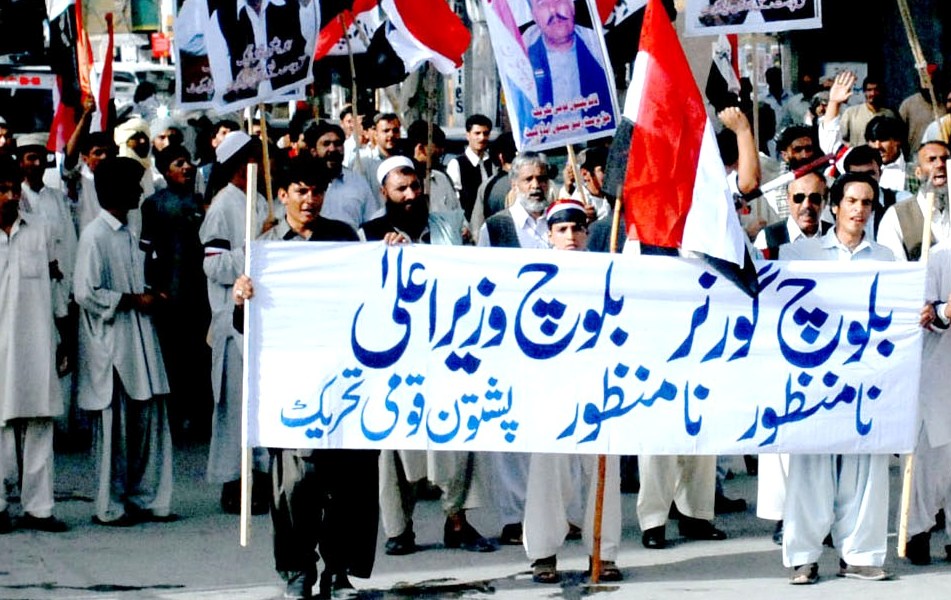
QUETTA: The Pashtoon Qaumi Movement (PQM) has said that in order to protect the rights of Pashtoon people a new province comprising Sibi and Zhob districts should be set up.

Addressing a public meeting here at Bacha Chowk on Sunday night, PQM chief Rafiq Pashtoon and other leaders said Pashtoons living in Balochistan did not have equal rights.

They said only a separate province could ensure them their due rights.

Rafiq Pashtoon said that Pashtoons in Balochistan had not identity, adding that people without an identity had no respect in society.

< Dawn News >

Friday, 11 January 2013

In Pictures: Carnage in Quetta, The day after

As many as 102 people had been reported killed on Thursday night in suicide and car bomb blasts in Quetta’s Alamdar Road area whereas 12 people were reported killed the same day when a bomb went off near a vehicle of the Frontier Corps at Bacha Khan Chowk.


< Dawn News >

Thursday, 26 July 2012

7 Coal Miners killed by Marri's BLA


Seven coal miners, who were abducted by a Baloch militant outfit have been killed, Dawn newspaper reported.
The coal miners were Pashtuns from Swat valley.
The Baloch Liberation Army,which Pakistan says is headed by London-based former Balochistan  education minister Hyrbyair Marri, had owned responsibilty for the abductions last week on his web site run from London.
Marri is also closely allied with a second deadly militant outfit called the Baloch Liberation Front, which is active in Mekran. The B.L.F. has killed 20 people in July alone, including 14 Punjabis, five Pashtuns and one Baloch.
Marri was tried for terrorism in London in 2008. Pakistan president Asif Ali Zardari had played a role for his freedom since Zardari is a bosom buddy of Marri's elder brother Gazzain Marri.
Some U.S. sources say Marri might be re-arrested in the backdrop of terrorist violence in Balochistan.

<Masti Khan Report>

Thursday, 28 June 2012

"Your Baloch is actually my Pashtun"


QUETTA: The evolutionary nature of Pashtun and Baloch people’s coexistence in Balochistan has transcended to a new complicated level, and in the process spawning a whole new range of complications with pronounced ethnic overtones.

In the numbers game, more people mean greater territorial claims. Indigenous Baloch appear loath to accept Baloch from Punjab as their own but at the same time are willing to own up local Christians and Hindus. It is common to come across Andrew Baloch or Madan Lal Bugti but many Baloch from Multan have been killed after being deemed Punjabi settlers. Brahui may have been a Dravadian language with a different history and roots but it is almost blasphemous to dub it as different from Baloch.

Pashtuns too do not lag behind in this competition to own fringe tribes and religions. Back home in Khyber Pakhtunkwa, at times, they tend to reject the non-Pashto speaking Niazis of Punjab as their own or accept the Pashto-speaking ‘kharay’ people of Peshawar as genuine Pashtoons. But here in Balochistan, they gladly own up tribes like Khetran, Bangalzai, Satakzai and Alizai as Pashtuns, even against the will of these tribes. Pashtuns make it a point that the champions of Baloch nationalism — the Khans of Kalat—are Qambrani Ahmadzai Pashtuns. And so are the Nawabs of Sarawan—Raisanis (Pashtun Tareens).

Politicians pick and choose selectively from glorified versions of history to maximize their claims in the upcoming battle for the division of Balochistan. Interestingly, both Pashtuns and Baloch agree on the division—at least on the surface.

Pashtuns maintain that the abolition of the West Pakistan as One Unit in 1970 created a Balochistan that had never existed in history. The unity of the British Chief Commissioner’s province—largely Pashtun territory except the leased Baloch areas of Kohlu-Bugti agencies, Naseerabad and Naushki-Chagai—was kept intact even after 1947. It was acknowledged as a separate entity from the Kalat states—-which Pashtun nationalist call as Baloch-Brahui confederacy—in the Independence Act of 1947 as well as in all constitutional formulas until 1970.

Baloch do not disagree, as yet. The late Khan of Kalat, Ahmad Yar Khan protested in a letter to Yahya Khan in 1970 that the Kalat states and the leased areas “do not want to be forced to become part of the rest of the Quetta division with which they do not desire to be merged.” Baloch Republican Party’s Brahmadagh Bugti has recently echoed support for similar boundaries, saying that ‘Azad Balochistan’ will incorporate only Baloch areas of Balochistan.

Here lies the catch: Which are the Baloch areas? one may ask.

Pashtunkhwa Milli Awami Party’s President Mahmood Khan Achakzai names 12 districts out of total 30 as Pashtun dominated. Baloch might not have a problem if Pishin, Killa Abdullah, Killa Saifullah, Zhob, Loralai, Musakhel, Harnai and Ziarat are mentioned as Pashtun districts. But they will have a big issue with Barkhan and Bolan dubbed as Pashtun districts. Tempers will further rise over Sibi and a complete war will be on cards if Quetta is conceded as Pashtun area.

Baloch quote record from the days of the mythical doyen of the Baloch identity, Chakar Khan’s great migration to these lands; how that epitome of Baloch glory, Naseer Khan Nouri established his independence from Afghan kings and how the successive Khans of Kalat leased Baloch lands to the British under duress.

Pashtuns counter with a matching reference from history—starting from Ahmad Shah Abdali, if not from the Mughal era: How Abdali conferred “the rule of Kalat” on Nouri in 1749; How the British acquired the Afghan domains of Pishin, Sibbi and—controversially—Quetta from the Khan of Kalat instead of its rightful owner, the Afghan king. They pile up records from the original royal decrees and revenue records of tribes, water rights and taxes from the British Gazette.

Bolan Pass being strategically crucial to both designs is critical. Pashtunkhwa’s former Senator Dr. Hamid Achakzai says the Pashtuns have a claim on the northern part of the Bolan Pass. Balochistan National Party (Mengal) leader Dr. Jahanzeb Jamaldini scoffs at the idea: “Pashtuns’ claim that their territory runs from Chitral to Bolan is funny— the fact is that neither do they have Pashtuns in Chitral nor in Bolan.”

The issue over Barkhan is even more interesting. It lies in the middle of the mineral rich Kohlu-Bugti agencies and Pashtun districts of Loralai and Musakhel. Pashtuns claim that the largest tribe of Khetrans in Barkhan is Pashtun. Ask a Khetran —- he will introduce himself as a Baloch. Pashtuns counter with a historical argument that the royal tribe of Khetran in Wahova (Punjab) say they are Pashtuns. Now who will decide the ethnicity of Khetrans, history or people?

The battle intensifies when the debate extends to Sibi. The lingua franca in the ancient town of Sibbi is Sindhi, seconded by Saraiki; the MNA and MPA are Baloch (Ahmadan Bugti on the national seat of Nawab Akbar Bugti and his son-in-law Bakhtiar Domki on the provincial), the locals in Sibbi town are a mix of Pashtuns, Baloch, Sindhis and Saraikis.

Pashtuns allege that the ethnic ratio of Sibbi is being changed. A Pashto dominated Harani has been made a district only to separate it from Sibi while the Baloch dominated tehsil of Lehri has been added to turn Sibi into a Baloch majority district.

Pashtunkhwa Party has already gone to the courts on this issue.

Pashtuns claim that Sibi was an Afghanistan district occupied by the British in the last century. It is house to the Pashtun tribes Barozais, Lunis and Khajjaks. But the Pashtun majority gets upset from the rigged voting in Dera Bugti and Kohlu, which are part of the national constituency. “They got as many votes from Lehri as there were total voters,” alleged Kabeer Afghan, President of Pashtun Students Organisation. “They have cut off Harnai from Sibi by closing down the historic railway line connecting the two.”

Baloch say that Sibi was always a Baloch territory even if it may have been under the Afghans at some stage. “But then boundaries have been overlapping among various empires in history,” says former Senator Manzoor Gichki. “It depends on how far you want to go into history.” History mixed with politics is lethal. It becomes worse when the battle turns into a war in Quetta.

<The News>

Friday, 4 May 2012

In Pictures: Exhibition,"A Broken Heart"

Quetta: “A Broken Heart: Help Heal a Wounded Country,” a photography exhibition of Hazarastan was held at General Mohammad Musa College Quetta.

Mr. Barat Ali Batoor, a talented professional photographer, organized the exhibition. Many of his photos from Hazatastan, particularly Bamian, were on display. Large numbers of people enjoyed the exhibition, highly praising Batoor’s talent.