Showing posts with label National Party. Show all posts

Tuesday, 16 July 2013

Exclusive Interview of CM Balochistan: Dr Malik Baloch


ISLAMABAD: Unlike his predecessors, he’s not a khan, a nawab or a sardar. He belongs to a middle-class family. An eye specialist by profession, he persevered in his 40-odd years of political struggle. In the end it was all worthwhile. Today, he’s the chief minister of Balochistan.

Dr Abdul Malik Baloch successfully led his National Party in the May 11 elections and clinched enough seats to form a coalition government with the help of Pakistan Muslim League-Nawaz and Pashtoonkhwa Milli Awami Party (PkMAP).

Dr Baloch is aware of the challenges his administration is faced with in a province reeling under a strange mix of ethno-political, sectarian and militant violence since 2004. And he appears to have a roadmap to steer his province out of the current mess.

“Restoration of peace tops my priority list,” 58-year-old Dr Baloch, a humble and soft-spoken politician, told The Express Tribune in an exclusive interview at Balochistan House in Islamabad.

The Frontier Corps has been accused of extrajudicial killing and illegal detention of ultranationalists and political workers in Balochistan. And Dr Baloch’s predecessor, Nawab Aslam Raisani, had tried, though unsuccessfully, throughout his tenure to bring the federal paramilitary force under his administration’s control.

On the contrary, Dr Baloch thinks the FC and political administration can work in synch for peace. “I don’t want confrontation with the Frontier Corps. We [provincial government and FC] will collectively solve all the issues facing our province,” he said.

Efforts by previous governments to win over a medley of Baloch separatist groups – including Balochistan Liberation Army (BLA), Baloch Republican Army (BRA) and Baloch Liberation Army – failed miserably in the past.

Dr Baloch, however, believes only political engagement is the way forward. “We are keen to bring the militants to the negotiating table with the help of the federal government,” he said. BRA chief Nawabzada Brahamdagh Bugti is living in self-exile in Switzerland, while BLA founder Nawabzada Herbiyar Marri is seeking political asylum in Britain. Dr Allah Nazar Baloch has been leading his BLF insurgents from his hideouts in Balochistan. Similarly, the Khan of Kalat, Mir Suleman Daud Khan, is also living in self-imposed exile in London.

Chief Minister Dr Baloch did not give a direct reply when asked if he planned to convince the Khan of Kalat to return to Pakistan. “He [the Khan of Kalat] is our honourable tribal leader,” he said in a terse reply.
Hundreds of families have been wrecked by raging violence in the province. Dr Baloch said his government would financially compensate the families who lost their members to violence. “The heirs of all those – including Punjabi settlers and Hazara community members who have been killed by terrorists and militants – are being paid Rs1 million each,” he added.

About the landmark 18th constitutional amendment which offered more autonomy to the provinces, the chief minister said he was happy that the federal government had recognised 50% share for oil and gas producing provinces on the revenue of their natural resources.

He refused to predict whether Chinese of American firms would be awarded the exploration licence for Reko Diq gold mines. “The matter is pending in the Supreme Court,” he added. “We’ll decide in the greater interest of Balochistan and its people.”

The previous administration had extended by five years the lease of Saindak copper mines exploration to a Chinese company. Dr Baloch, however, has reservations on the terms and conditions of the lease agreement. “We’ll take up the issue with the federal government to get our reservations addressed by the Chinese company,” he said.

The chief minister is also aware of the challenges his administration is facing in the health and education sectors.

“All government departments, particularly educational institutions, have collapsed during the last decade. The provincial government spends Rs25 billion annually on the salaries of teachers – yet the quality of education is still deplorable,” he said.

The situation in the health sector is no better. “Recently, we conducted a raid at state-run hospital in Chaman district. There were 17 doctors and 14 were missing,” he said.

Dr Baloch warned that he would not tolerate absenteeism at government offices. “I reach my office at 9am sharp and expect the same from all government functionaries, particularly senior bureaucrats. The bureaucracy will have to submit to the change,” he said.

Coming to the financial issues of the province, the chief minister accused the previous coalition governments of massive loot and plunder of public funds. “Balochistan witnessed unprecedented corruption which has resulted in the destruction of the province during the last 10 years,” he added.

However, Dr Baloch said he was not aware of any inquiries by the National Accountability Bureau against his predecessor, Nawab Aslam Raisani, his cabinet members, legislators and or any government official.

<  Express Tribune >

Tuesday, 4 June 2013

The Baloch: Dr Abdul Malik


QUETTA: Dr Abdul Malik Baloch — nominated for the post of Balochistan chief minister — will be the first chief executive of the province who is neither a tribal chieftain nor member of any family of former rulers of princely states.

A medical doctor by profession, Dr Malik belongs to a middle-class and educated family of Kech district.

Born in Sigenisar village near Turbat in the family of Haji Abdul Salam, a zamindar, Dr Malik got his early education from a village school and did his intermediate from the Government Collage, Turbat.

He completed his MBBS from the Bolan Medical College and later specialised in eye surgery. He ran a clinic in Turbat for a brief period before entering active politics.

Dr Malik played an active role in Baloch Students Organisation (BSO). In 1987, he formed a political party — Baloch National Youth Movement (BNYM).

Not satisfied with the performance of the BNYM, he later formed Balochistan National Movement (BNM) with Dr Abdul Hayee Baloch as its chairman.

Dr Malik first contested election in 1988 for a Balochistan Assembly seat from the platform of Balochistan National Alliance headed by Nawab Akbar Khan Bugti and Sardar Ataullah Mengal.

He won the seat and was made health minister in the cabinet of Nawab Akbar Bugti. In 1993 general elections, he won a provincial seat and served as education minister in the cabinet of Nawab Magsi.

In 2004, the National Party (NP) came into existence as a broad-base political party with the merger of Dr Malik’s BNM and Mir Hasil Khan Bizenjo’s National Democratic Party.

Dr Hayee was elected first president of the NP and now Dr Malik is its head. From 2006 to 2012, Dr Malik remained a member of the Senate and aised his voice on the issues of Balochistan in the upper house of the parliament.

He played a major role in discussions over the 18th Amendment and in encouraging the PPP to surrender the entire Concurrent List of the constitution to provinces.

Dr Malik is considered as the most popular leader of the NP among party activists.

During the campaign for the 2013 general elections he managed to win the sympathy and support of tribal chieftains and sardars who won their traditional seats.

The main challenges before Dr Malik as chief minister would be the problem of corruption in the province, the missing persons issue, security challenges and good governance.

Political observers are of the opinion that Dr Malik would have face big challenges as the chief minister of the province, but most of them say he has the ability to rid the province of its ills and put it on the right track.

< Dawn >

Friday, 5 October 2012

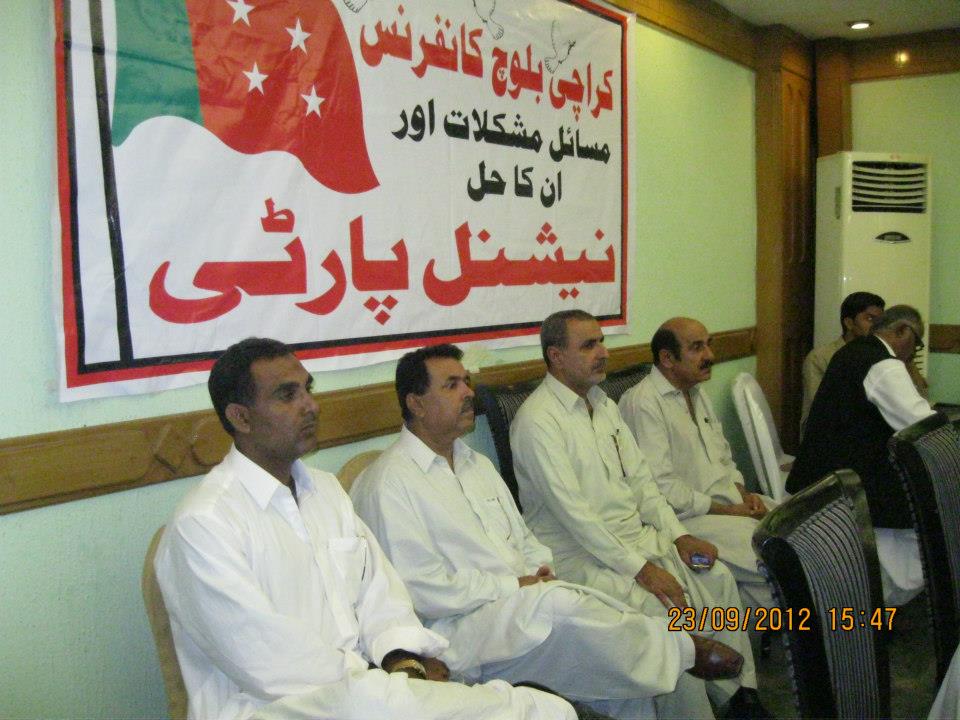
In Pictures: Karachi Baloch Peace Conference

"Karachi Baloch Peace Conference" was held on 23-September-20102  by National Party & BSO Pajjar in Karchi.


Thursday, 12 July 2012

Baloch Vs Baloch: Maula Baksh Dashti 2nd anniversary


Thousands of people in Mekran paid glowing tributes to slain political activist Maula Bakhsh Dashti in Turbat Wednesday.

People from all walks of life from Dasht, Buleda and Tump gathered in Turbat to pay homage to Dashti on the second anniversary of his assassination by the militant Baloch Liberation Front.

A large number of Baloch women also participated in the rally.

The commemoration to pay tributes to Dashti and other martyrs was organized by the National Party, a Baloch secular and democratic party, that draws its political inspiration from the teachings of the late Mir Ghoush Bakhsh Bizenjo, one of the founders of modern Baloch nationalism who like Dr. Martin Luther King believed in non-violence.

Dr. Malik Baloch, president of the National Party, showered praise on his assassinated colleague and said because of its resources and strategic location Islamabad and other foreign powers were casting an evil eye on Balochistan.

He said workers like Dashti were an obstacle in the way of those conspiring to sell Balochistan for their selfish interests and that was the main reason he was eliminated.


Others who spoke on the occasion included the slain leader's young son Mohammed Jan Dashti, poet Basheer Bedar, former speaker of the Balochistan assembly Mir Akram Dashti, former member of the National Assembly Dr. Yasin Baloch, Engineer Hameed Baloch, Pullain Baloch, Shakeel Advocate and Yar Jan Buledi.

Mohammed Jan Dashti, son of Maula Bakhsh Dashti, paying tributes to his father. The militant B.L.F. has also threatened to kill the son.

During the last two years the B.L.F. has killed at least 100 Baloch in the Dasht area on a false charge of being government informers, according to political sources in Mekran.

The late Dashti, who had nearly four decades of public service behind him, has quite a few close relatives and friends in the U.S. and Canada.

Along with the Balochistan National Party led by Baloch Nelson Mandela Sardar Akhtar Mengal, the National Party has the best political cadres in Balochistan.

<Masti Khan Report>