Showing posts with label Earthquake. Show all posts

Wednesday, 22 January 2014

In Pictures: Dr Malik Inaugurates Sport Complex In Quake-Hit Awaran

The Chief Minister Dr Abdul Malik inaugurated a children’s park in the district and distributed cheques among those affected by the quake. He inaugurated the area’s Sports Week, organized by local administration and the army as well as a sports complex and announced 5 million rupees for the district’s sports committee. 


Saturday, 18 January 2014

Al-Khidmat Punjab Presents Cheque of Rs.1,700,000 for Balochistan Earthquake Victims


President Al-Khidmat Foundation Punjab, Rao Muhammad Zafar presented a cheque of Rs. 1.7 Million for the relief & rehabilitation of Balochistan Earthquake victims to President Al-Khidmat Foundation Pakistan, Dr. Hafeez ur Rehman in a meeting at Lahore. In addition to this amount AKF Punjab's total contribution has reached at 6 Million PKR.

A review meeting on Balochistan Earthquake Al-Khidmat Relief work has been arranged in Al-Khidmat Head Office Lahore. President Al-Khidmat Foundation Pakistan has paid special compliments on the good effort of AKF Punjab regarding Balochistan Quake victims.

Apart from this, Al-Khidmat Foundation Punjab also sent Eid Gifts on Eid ul Adha comprises of cash Rs. 200,000, 1,000 Suits of Rs. 700,000, 250 Ration packs of Rs. 650,000, meat of Qurbani, mineral water bottles, milk packs & general medicines as eid gifts for earthquake victims of Balochistan.

< Alkhidmat Punjab >

Wednesday, 15 January 2014

Punjab gives Rs100m goods for Balochistan quake victims


QUETTA: The Deputy Speaker of Punjab Assembly, Sher Ali Gorchani, visited the earthquake-hit Awaran district on Wednesday and handed over relief goods worth Rs100 million to the Balochistan government on behalf of the Punjab government under the Chief Minister’s winter relief package.

Speaking on the occasion, Mr Gorchani said that people of Punjab would continue to support their quake-hit Baloch brethren till their complete rehabilitation.

“The people of Punjab will continue to stand shoulder to shoulder with Baloch people during this hard time,” he said.

He said 30,000 blankets and 60,000 quilts had been provided to earthquake survivors in Awaran. He said the people of Punjab had so far sent relief goods worth over Rs280m and contributed Rs259m to the Balochistan Relief Fund.

Mr Gorchani said the Punjab government would establish a modern hospital in Awaran and construct a model village. He said that children of Awaran would also be granted admission to medical colleges of Lahore.

The deputy of speaker also visited Mashi, a village badly affected by the earthquake, and distributed relief goods among people.

Talking to the area people, he said there was close coordination between governments of Balochistan and Punjab about distribution of relief goods.

He gave away winter relief packets among the area residents.

< Dawn >

Saturday, 4 January 2014

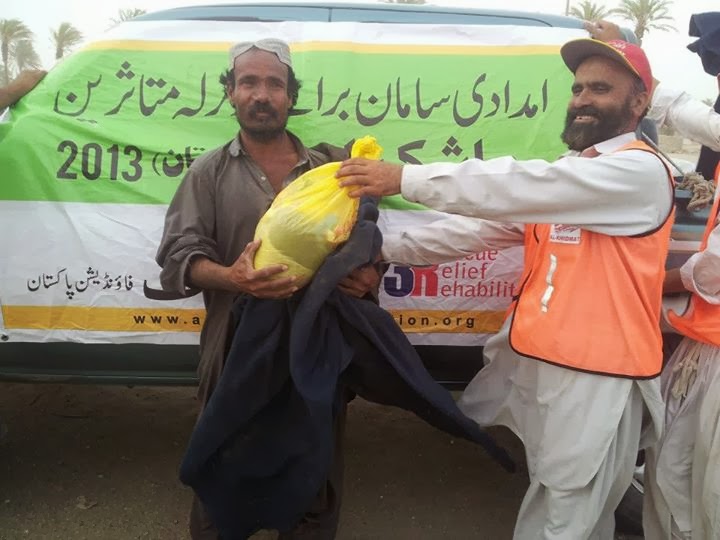
In Pictures: Al-Khidmat Relief Activities In Balochistan

The deadly quake that hit the coast line of Southern Pakistan (Balochistan) has devastated Awaran and Turbat areas. Al-Khidmat Foundation has been carrying out its rescue and relief activities in the areas in spite the fact that the local population is well-spread out in vast vicinity.


Friday, 27 December 2013

Rs22.2m for Balochistan quake survivors from Punjab

File Photo: Mian Mansha gives fifty million in CM relief fund for Balochistan earthquake

LAHORE: A sum Rs 22.2 million was presented to Punjab Chief Minister Shahbaz Sharif on behalf of the eminent figures of the province as donation for the Balochistan quake affectees.

A senior leader of PML-N Saleem Saif Ullah Khan gave a cheque for Rs. 10 million on behalf of Saif Group, Chairman Flour Mills Association Founder Group Bilal Sufi Rs 2.7 million, MI Khurram Rs 2.5 million on behalf of Quaid-e-Azam Industrial Estate, Commissioner Rawalpindi Rs 5.5 million on behalf of various personalities of the city, Meezan Bank Rs two million, Shahid Hussain Rs one million on behalf of Service Sale Cooperation Limited, Sadiq Saleem Rs eight lakh on behalf of Crescent Textile Mills Limited, prominent social worker of Okara Mian Rashid Rs. five lakh, Waseem Ahmed Mehmood Rs one lakh on behalf of Shezan International, while Member National Assembly from Bahawalpur Begum Sabia Nazir presented a cheque for Rs 50,000 each.–Staff Reporter

< The Nation >

Friday, 6 December 2013

Earthquake relief: President gives CM Balochistan Rs50 million for Awaran victims


President Mamnoon Hussain presented a cheque of Rs50 million to Chief Minister Balochistan Dr Abdul Malik Baloch for the relief of Awaran earthquake victims.

Dr Baloch called on President Mamnoon Hussain at the Aiwan-e- Sadr on Saturday. The Balochistan Provincial Minister Abdul Rahim Ziartwal and Chief Secretary Balochistan Babar Yaqoob Fatah Muhammad were also present during the meeting.

The leaders discussed the overall situation in the province, particularly the efforts being made for the relief and rehabilitation of Awaran earthquake affectees.

The President expressed his solidarity with the victims and presented the cheque as a contribution for the relief of the people affected by earthquake in Awaran district.

He assured the Chief Minister that the federal government was fully committed to Balochistan’s socio-economic development and a removal of the sense of deprivation among its people.

As the Chief Minister Balochistan apprised Mamnoon Hussain on his government’s relief activity, the President advised the provincial government to gear up efforts for permanent rehabilitation of the affectees.
He also emphasized the need for a concerted and coordinated response by all concerned agencies including NDMA, PDMA and others.

The Chief Minister thanked the President for his gesture and keen interest in the uplift of the province.

< Express Tribune >

Thursday, 5 December 2013

Italy to donate Euros 300,000 for Balochistan earthquake victims

File Photo: Pakistan army helicopter taking the goods for Balochistan earthquake vicitms

ISLAMABAD : The Italian government has offered donation of 300,000 Euros to Pakistan government for the rehabilitation of earthquake affected people in Balochistan. Italian Ambassador in Pakistan, Chiodi Cianfarani who called on the  Finance Minister, Senator Ishaq Dar here Sunday morning, conveyed the sympathies of the people and government of Italy over the recent earthquake in Balochistan and offered to donate 300,000 Euros for the earthquake affectees.

He informed the Finance Minister that the Italian government would  provide debt relief of Rs5.7 billion to Pakistan for spending on government’s Poverty Alleviation programme and Citizens Damage Control programmes.

In addition, Italian Vice Minister of Foreign Affairs plans to visit Pakistan along with a business delegatio, the ambassador said adding that his country was keen to expand the existing bilateral economic relations between the two countries.

The Finance Minister said that Pakistan values its relations with  Italy and is keen to expand economic ties with it He thanked Italy for supporting Pakistan’s case in IMF and expressed the hope that it would also extend its support in European Union for grant of GSP plus to Pakistan.

< APP >

Tuesday, 26 November 2013

Samsung Provides Relief Goods for Earthquake Victims

Mr. Saad ul Hasan Head of Corporate Marketing Samsung Pakistan handing over food supplies for earthquake affectees to Pakistan Army.

Samsung Electronics has provided food assistance for the earthquake victims of Baluchistan. A press statement said.

Baluchistan was hit by two major earthquakes with a gap of four days. The earthquakes with the intensity of 7.7 and 7.2 magnitudes respectively, jolted the Awaran and Kech district of Baluchistan. It turned the majority of mud brick houses into rubble in a matter of seconds and created a humanitarian crisis.

Mr. John Park, MD Samsung Pakistan said, “In recent calamities in Baluchistan, Samsung Pakistan and its employees have contributed with open arms and will remain devoted for the cause of humanity.”

The arrangement of relief goods from Samsung Pakistan employees has helped cater to the severe shortage of food in the affected areas of earthquake. Notably, Samsung has been an active donor and contributor to the social welfare activities in Pakistan.

< Pro Pakistani >

Monday, 25 November 2013

Special report: The Awaran earthquake – Fear in a handful of dust


Dust and dust storms are all that one sees in Awaran. When the haze clears, it is only to reveal abject poverty, lawlessness, an utter lack of governance and, of course, the death and destruction caused by the recent earthquake. This is one of the most neglected parts of Pakistan’s most neglected province, and the fruits of that neglect are bitter indeed.

Some journalists call Awaran ‘the hotbed of the biggest insurgency in Pakistan’, with the army and separatists being the ‘real’ stakeholders. Each has its own wins and losses to proclaim and its own version of events to disseminate to the media, and thus on to the people. The fog of war hangs in the air, making it hard to see those who pay the price: the inhabitants of this forsaken land.


They hardly feature in these conflicting narratives, these dispossessed that do not conveniently fit into either the ‘traitor’ or ‘patriot’ category. What they do is that they feel. They feel hungry, they fall prey to not just disease, but also frustration at the lack of opportunities and the lack of hope that someday, something may change for the better. And when you ask them about their lives, the first emotion they express is surprise.

“Are you really going to write about me?” This is what Amina, an expecting mother said when asked about her losses in the September 24 earthquake. After getting an affirmative response, she looked towards her mother-in-law. Once the ageing matriarch gave her approval, Amina spoke at length about living in a tent, separated from the elements by only a thin sheet of fabric, like so many other earthquake survivors.

“I have been getting relief goods but so far no one has come forward to help us in rebuilding our homes,” she says. A resident of Jakaro, she says that they had barely fixed their home which was damaged by the preceding years’ heavy rainfall. Then the earthquake struck, and all was reduced to rubble.


Seeing Amina talk, other women in the cramped examination room of District Headquarter Hospital Awaran also began to speak up about their ordeal. Some had lost homes, others lost family members.

Even the men accompanying them, frustrated with a lack of jobs and steady income, admit to feeling emasculated. They are unable to provide for their families, and the fear of more devastation — whether natural or manmade — is etched in their weary eyes.

Falling through the cracks

A month has passed since the earthquake rocked the Awaran and Kech districts of Balochistan, an expanse with a total area of 40,000 square kilometres. Measuring 7.7 on the Richter scale, its epicenter was 120km south-west of Khuzdar in district Awaran. Some 386 people died in the quake, and thousands of homes were destroyed. So intense was the quake that it was felt in many cities of Pakistan and resulted in a new island emerging near Gwadar.

Balochistan is no stranger to natural disasters. Earlier this year, an earthquake measuring 7.9 on the Richter scale hit Southern Iran, with the tremors causing substantial damage in Balochistan’s District Washuk’s Tehsil Mashkhel. Thirty-five deaths were confirmed by the National Disaster Management Authority (NDMA) back then. Then there were the quakes in 2007 and 2009 in Ziarat and the floods in 2010 onwards. Much before that, there was the 1935 Balochistan earthquake, where in Quetta alone over 20,000 casualties were reported. That toll in a single quake remained unmatched until the 2005 Kashmir Earthquake, in which some 90,000 people lost their lives.


But it isn’t just the relatively lower casualty count that makes the response to the Awaran quake different from the others.

The area features lowest on all development indicators, be it education, health, food security or the economy. It is also arguably the least governed place in Pakistan.

In the crosshairs

Then there is the fact that it happened in an area that is the hometown of Dr Allah Nazar, a Baloch separatist leading the Balochistan Liberation Front (BLF).

“Awaran was an ungoverned space for the last ten years and providing relief and following it up with rehabilitation is a difficult task, which requires massive planning and finances,” says Dr Mohammad Akbar, Commissioner Kalat.

He stressed that security remains the biggest issue with insurgents “doing anything and everything possible to stop aid delivery and rehabilitation. But that does not mean we stop and give up.”

Echoing similar sentiments is Major Gen Samrez Salik who is leading the relief and rehabilitation operation in Awaran.


“The army is here to help our fellow Pakistanis and we do not intend to carry out an operation,” he said.

He was one of the army officials to have survived an attack last month when rebels fired rockets at a helicopter carrying the NDMA chief Major General Saeed Aleem.

Despite what the army claims as repeated attacks on security personnel as well as on the local population who were allegedly beaten by insurgents for taking relief goods, the army says it has exhibited maximum restraint while the ISPR also denied conducting an operation in Awaran and Mashkey.

Stressing repeatedly that the army would not indulge in combat, Major General Aleem was however unable to give a timeframe as to when the army would move out.

“The armed forces of Pakistan are mandated to assist in natural calamities and that is what they are doing in Awaran as well,” says Brig Mirza Kamran Zia, spokesperson of the NDMA.

Naturally, there are dissenting views. A Baloch Students Organisation representative insists that the army has its own plans and goals, and that these do not include caring for the wellbeing of the Baloch people.

“The government should allow international aid to come and let impartial NGOs carry out relief and rehabilitation work. We do not need the army’s aid and time and again our people have refused it,” he says.

He also alleged that an operation was being conducted and that “people are being forced out of the area.”

“Large numbers of people are leaving Mashkay and other areas. These people are already hard-pressed for food and aid and now they have been forced to leave their homes,” he said.

When questioned if there is a solution to this mess, a BLF supporter, on condition of anonymity, said: “The democratic set-up must be allowed and civil administration must be empowered. It’s fine if the army is doing relief work but it should now leave. Military and intelligence agencies must back off and let government rule prevail.” This is clearly not the official line of the BLF, which otherwise claims it wants nothing short of an independent state.

The past is not another country

“On March 12, I move my camp some 18 miles down to the rest house of Awaran, situated on the left bank of the Mashkai river at an elevation of about 1,750 feet where the direct overland line of the Indo-European telegraph running from Karachi to Panjgur and Kirman passes,” wrote explorer and surveyor Sir Aural Stein in the year 1929 in ‘An Archaeological Tour to Gedrosia’. In the chapter titled ‘Ruined mounds of Buzdad and Awaran’, he described the town’s poverty and dependence on the vagaries of climate for its survival.

Little has changed since then. In fact, poverty has increased and so has the remoteness of the area due to the utter lack of a communications network. Add to this the fact that there has been no governance for over a decade now, rehabilitating Awaran remains a tough task.

Development agencies say that even if the number of affected population is low, some 200,000 people as compared to the 2005 Kashmir earthquake (3.5 million) and the 2010 floods (1.5-1.8m), the situation is no less horrible.


A rapid assessment conducted by 11 non-governmental organisations across 296 villages in Awaran and Kech districts, states that 80 per cent of the houses have been damaged or destroyed. Due to widespread poverty across villages, only 7pc of the affected households have adequate resources to buy food. In terms of health, 54pc of health facilities are destroyed and 46pc are partially damaged. Malaria, respiratory tract infections, diarrhoea and skin diseases are widespread.

No Entry

The biggest criticism the government has received so far is based on its not allowing international NGOs (INGOs) in the area and instead relying on the Army and, to a lesser extent, local NGOs.

This was not the case in 2005, when Pakistan was widely praised for its relief activities, not just by local and international NGOs but also the UN.

Back in 2006, UN Office for the Coordination of Humanitarian Affairs (OCHA) Abu Diek commented: “Cooperation between [the] UN and [the] military has been exceptionally unprecedented. The UN has to rewrite its books about civil/military cooperation.”

This time around however, the decision to involve the army and the exclusion of international agencies was critiqued, with nationalists accusing the army of occupying Balochistan in the garb of providing relief. “At this point, we are more focused on delivering aid,” says a government official in response to a question about INGOs access. “The government can manage the disaster on its own and that’s the reason why we did not appeal internationally for assistance. Getting INGOs onboard would mean diverting our human resources towards their protection,” a government official said.


He recalled that all United Nations operations were shutdown after the kidnapping of UNHCR sub office Chief John Solecki in 2009. Solecki was said to be kidnapped by the Balochistan Liberation United Front while the then interior minister Rehman Malik had alleged that Brahamdagh Bugti was behind the move. “Unicef had stopped its relief activities in the earthquake stricken districts of Ziarat and Pishin and the communities there were left in a lurch,” he recalled.

“Awaran is a difficult area. If something happens to a relief provider of an INGO, all of them will shut down operations and leave. We cannot afford to have that happen. The government is committed to help alleviate the status of the people in Awaran and our development roadmap is taking shape. The local NGOs have shown remarkable bravery in working in a hostile area,” he added.

None of the local NGO workers have been attacked so far by the insurgents.

In response to Dawn’s question about the aid flow that seems to be decreasing and the challenges that the people would be facing, UN OCHA representative Dan Teng’o said that in addition to continuing the current relief work, it is crucial to take a special notice of the expected drop in temperature in winter (potentially to extreme low) and the impact this is likely to have in terms of further worsening the conditions of affected communities.

It is worth noting that a Dawn report published earlier highlighted that the UN had no physical presence in the area and there were no projects by UN development agencies.

Médecins Sans Frontières (MSF) or Doctors Without Borders is an INGO that was denied access in Awaran despite the fact that it has many programmes running in various districts of Balochistan. Like the UN, for MSF too Awaran is alien territory.


In a recently published column, Chris Locklear, MSF’s head, cited security as a reason for not being allowed in the area.

Meanwhile, security sources say another possible reason for not allowing foreign NGOs in the area has to do with ‘digital mapping by vested interests’.

In the aftermath of the 2010 floods, the Ministry of Defence came up with the proposed Land Surveying and Mapping Bill 2012, according to which drafting a map by any unauthorised person is an offence.

A salient feature of the bill reads: (iv) to stop unqualified/unregistered firms from taking part in surveying and mapping activities that could pose a security risk to the state.

“During the 2010 floods, several NGOs used their relief workers in mapping information all over Pakistan, including sensitive spots. Balochistan is a sensitive zone and we cannot take any risks,” the source said.

A Dawn news report dated 19th November 2012 quotes the NDMA chairman Zafar Qadir as saying that an INGO named the Information Management and Mine Action Programmes (iMMAP), continues to map flood devastated areas using the Geographic Information System (GIS) despite having been declared a ‘security risk’.

“Despite a lapse of 11 months, the iMMAP has failed to develop the web-based programme in accordance with the NDMA’s specifications. The NDMA disassociated itself from the iMMAP in January,” Dr Qadir said at the time.

The foreign ministry in a letter on April 12, 2012 said: “Presence of iMMAP in Pakistan will not only give an incorrect message internationally but can also pose serious problems for Pakistan at international fora and create confusion among the stakeholders.”

It said the mission statement of the iMMAP focused on mines clearance and it usually operated in conflict zones, and thus had no business conducting mapping in flood-affected areas.

The same report quotes an official in the economic affairs division as saying, “There is no monitoring of NGO personnel once they are given permission to help the government in emergency situations.” This, at least, is part of the reason the government is refusing to allow INGOs into Awaran.


‘Roadmap Awaran’

The government has stated that the rebuilding phase will be carried out by the Army in collaboration with the Balochistan government and NDMA.

With an area of 21,630 km², Awaran is much bigger than FATA. The metalled (black top) road that connects Awaran to neighbouring districts is 49km in length. In district profiles done by the government and NGOs, Awaran, which was turned into a separate district in 1992, has always been classified as 100 pc rural.

The area is prone to natural calamities, with earthquakes and flash floods being the most hazardous. In 2007, Awaran was affected badly after heavy rains and flash floods swept through it, leaving behind a trail of broken mud homes.

No relief package has been announced so far by the government of Balochistan or the federal government following the earthquake. A similarly apathetic attitude was shown when over 700 houses collapsed in Mashkhel earlier this year.

“The Initial Damage Assessment is almost complete and so far the numbers are pretty similar to the figures we have released in our daily reports,” says Brig Zia.

The figure released by NDMA on Oct 21 stated that 32,638 houses have been badly damaged while 14,118 suffered partial damage.


Getting Awaran back on its feet will be a Herculean task given that most of its government offices are non-functional and the place had negligible economic activity to begin with.

Schools exist on paper but not in reality. The few that do are barely functional, like the public school in Labach, a village 6km away from Awaran town, which has a badly damaged building. That does not mean that the desire to be educated does not exist. In fact, villagers stressed that they would like their children to go to school even in an open field, so long as there were teachers.

The DHQ Hospital Awaran is another badly neglected place. On paper, it has a staff of 20, including doctors and paramedics, but none of them actually stay in Awaran. The Medical Superintendent lives in Quetta while the paramedical staff, usually from other areas of Pakistan, is too scared to work due to safety reasons.

The entire district has only one lady medical officer, Dr Rahat Jabeen, who works as a General Practitioner and a gynaecologist. Though the DHQ Hospital has no medical equipment, Dr Jabeen says she often ends up carrying out ultrasound examinations on patients at her maternity home, a few minute’s walk away from the public facility. If one is to listen to the NDMA, all that may change for the better.


“We are working on the Early Recovery Plan (ERP) which envisages functional schools, hospitals, Basic Health Units (BHUs) and Rural Health Centres (RHCs) to facilitate people. Half of the water supply schemes in the area have been made functional as well,” Brig Zia claimed.

“After the early recovery plan, we will start with the Comprehensive Reconstruction Plan which will at least take two to three years. Compensation for the affected families will be decided and the focus will remain on uplifting the area,” he added.

Building without blocks

As always, this is easier said than done.

The National Disaster Risk Reduction policy stresses on strengthening community participation and resilience but in Awaran that has never happened to date. The NDMA and PDMAs work all over Pakistan with community based organisations (CBO) and NGOs but that is an unlikely case in Awaran.

“There are no NGOs working in Awaran. Some CBOs exist but they are unable to get necessary funding from donors and do not have the capacity to run advocacy campaigns let alone participate in rebuilding projects. The concept of Disaster Risk Reduction is not something the CBOs here are familiar with,” a local journalist said.

The rehabilitation efforts and rebuilding after the 2005 Kashmir Earthquake and the Attabad Lake are proof that an area can be turned around after disaster. However, the technical expertise of many NGOs that were part of the operations back then, remain unutilised.

When contacted for comments, staff at the Earthquake Reconstruction and Rehabilitation Authority (ERRA) said they were not in a position to speak about Awaran. While the authority did some good work, it is now on the verge of being closed down by the government.

A consultant for ERRA stressed that low-cost quake-proof housing was essential. “Mud and unbaked bricks along with wooden beams and date leaves are used for construction of homes in Awaran and most rural areas in Pakistan. A reason for the low death toll, despite the severity of the quake, is that people were living in mud houses. Those with better finances go for concrete housing but that does not mean that it is safe,” the consultant said.

On an average, constructing a proper housing unit using bricks, cement, iron beams, etc. would cost at least Rs100,000 to an individual. State run low-cost housing schemes and indigenous construction methods along with modern techniques can bring down the costs drastically.

With winter approaching, it’s crucial that for the people living in tents, some shelter is quickly made available.


Architect and ERRA board member Yasmin Lari says that it’s a must to focus on vernacular architecture and strengthen structures. “Learn from tradition, bring in innovation” is her logic.

She is currently training a team of Balochistan University teachers and students who have the goal of rebuilding model houses in Awaran with a grant from the Heritage Foundation. Given her experiences in the 2005 earthquake and later the floods, she has been able to come up with low-cost housing that can withstand major damage.

“Lightweight structures are essential as these are less likely to fall. Also, avoid using heavy materials for roofing. At this point I suggest 10ft x 15ft one-room units with retrofitted walls and roofs. These can be built within three weeks,” she says, stressing that work must be expedited or “the fast approaching cold weather will slow down the brick drying process and increase construction time”.

She also stresses that the community must be involved in the rebuilding process. “It’s cathartic. It’s not just the physical challenge but the psychological challenges as well that need to be considered. You build houses with them and their spirits are lifted,” she says.

Out in the cold

The residents of Awaran and Kech don’t hold out much hope. A month after the quake, their biggest concern is getting adequate supplies for the coming winters.

It is worth noting that according to an integrated food security phase classification (a set of tools and procedures to classify the nature and severity of food insecurity) conducted in March with the participation of public officials, UN agencies and other organisations related to food security, the districts of Awaran and Kech were classified Phase 3 (crisis or highly food insecure). With the impact of this earthquake, it can thus be estimated that the affected areas are now in Phase 4 (emergency) as per the classification criteria, which makes a case for immediate need of humanitarian assistance.


“Winters will make the communities vulnerable. The government needs to devise a way to provide immediate shelter or infant and child deaths will be the next big news. The media has already forgotten our plight and the aid flow is now decreasing,” says Zahid Baloch, focal person of the Awaran Disaster Response Forum, the coordinating agency in the affected area.

For now, though not being led by the dreams of a better future, the residents of Awaran and Kech are rebuilding their homes on self-help basis, ready to face the harsh winter and harsher realities as the dust around them refuses to settle.


< Dawn >

Monday, 18 November 2013

UAE aid for Balochistan earthquake victims


KARACHI: Relief assistance was distributed among 20,000 families of Mashkhel, Baluchistan by the Sheikh Khalifa Foundation of United Arab Emirates on Friday. A ceremony was held to distribute the relief goods among affected people in Korangi at TCP Godown No.22 at which Head of Operations of Sheikh Khalifa Foundation Mr. Abdul Raheem Jani was present.

He said that the Sheikh Khalifa Foundation of United Arab Emirates, in keeping with its tradition of helping its brothers and sisters in need, had decided to provide humanitarian aid to the earthquake affected people.
He added that the Sheik Khalifa Foundation is sending 16,000 relief bags containing rice, sugar, wheat, pulses, dates, cooking oil, milk, tea, beverages besides 1,500 tents for shelter. The above mentioned aid will help at least 20,000 families of Baluchistan.

Besides Head of Operations of Sheikh Khalifa Foundation Mr Abdul Raheem Jani, diplomats were also present on the occasion.

< The Financial Daily >

Wednesday, 13 November 2013

Balochistan police donated relief goods for Awaran quake victims


Balochistan police have donated seven truckloads of relief goods for the earthquake victims of Awaran.

The relief goods were handed over to Director General Provincial Disaster Management Authority‚ Hafiz Abdul Basit by Inspector General of Balochistan Police‚ Mushtaq Ahmed Sukhaira in Quetta on Wednesday.

< Radio Pakistan >

Monday, 11 November 2013

45,840 tents distributed among Balochistan earthquake victims

File Photo:Pakistan Navy Official handing OVer Relief Goods For Earthquake Victims to Commissioner Turbat

Wednesday , Islamabad—As many as 45,840 tents have so far been distributed among the people of earthquake hit areas of Balochistan by various relief providing agencies, says the latest data released by National Disaster Management Authority (NDMA). The organizations, which have distributed relief items, include PDMAs, NDMA, Army, Navy and civil society organisations (CSOs).

As many as 27,935 blankets, 19,540 plastic mats, 23,200 mosquito nets, 41,690 mineral water bottles and 2008 miscellaneous items including jerry cans, water tanks, water filtration plants and generators have so far been distributed among the quake hit people of Balochistan and Sindh.

Meanwhile, the Civil Society Organisations (CSOs) have so far donated 3,500 tents, 12,286 ration packs, 15,530 mineral water bottles, 553 water tanks, 20 water filters, 85 pot sheets, 50 tons high energy biscuit cartons, 40 plastic sheets, 2,012 mosquito nets, 5,000 blankets, 65 biscuit cartons, 150 quilts, 10 water plastic sheet cartons, 50 CGI sheets, 1,000 jerry cans, 450 water coolers and 15 tons milk. Some 12.079 ton medicine has been donated by China.

Upto Sunday evening, a total of 15,899 patients have been treated in Awaran and 1709 in UC Dandar. A team of 28 doctors, 53 paramedics equipped with 34 ambulances is providing treatment to the quake hit people of Awaran. So far essential life saving drugs worth Rs 4,500,000, a Trauma Kit and eight tons medicines have been provided to the needy.

In Masjkal, 18 doctors, 10 paramedics and 4 ambulances are engaged in providing medical treatment facilities to the deserving people. In Dandar, six doctors, eight paramedics and four ambulances are providing quality medical services to the quake hit people.

Meanwhile Director General, Provincial Disaster Management Authority, Commander (retd) Syed Sulaiman Shah has said that the people of Sindh are wholeheartedly supporting the earthquake victims of Balochistan, particularly those belonging to Awaran. Talking to journalist Tuesday after despatching relief goods donated by private Korean companies, he said the people of Sindh were not only making donations for their brethren in Balochistan, but were also facilitating other donors in this regard.

He said as per directives of Sindh Chief Minister Syed Qaim Ali Shah, PDMA was continuously engaged in relief work for the Awaran victims. Replying to a question, the PDMA DG said the relief goods donated by foreigners were handed over to the Deputy Commissioner Awaraan. Donations by Korean companies included 325 ration bags, 100 blankets,120,000 packets of biscuits and other items of general use.—APP

< Pakistan Observer >

Friday, 8 November 2013

Awaran Earthquake: K-P CM donates Rs80m for victims


KP CM giving aid cheque to CM Balochistan for Earthquake victims

QUETTA: Khyber-Pakhtunkwa (K-P) Chief Minister Pervez Khattak has announced Rs80 million for rehabilitation of Balochistan earthquake victims. To express solidarity with the province, Khattak presented Balochistan chief minister with Rs80 million cheque. “I came here to express solidarity with the people of Balochistan at this difficult juncture,” he said, adding, “both K-P and Balochistan face similar issues.”

< Express Tribune >

Wednesday, 6 November 2013

Army sends 200t relief goods to Balochistan


LAHORE: A large consignment of relief goods weighing 200 tonnes was dispatched by road from the Army Relief Camp Fortress Stadium for earthquake victims of Balochistan on Wednesday.

Pakistan Army Lahore Garrison has already dispatched 139 tonnes of relief goods to the affected areas in four consignments before Eid.

Earlier, Brigadier Mazhar Kayani, commander of the Logistics Lahore Garrison, informed the media that 400 tonnes of relief goods had been collected in Army Relief Camps in Lahore. He said that 139 tonnes of food items and medicines had already been transported to the quake-hit areas. He said that with inclusion of Wednesday’s consignment, a total of 339 tonnes of rations and other relief items would reach the calamity-hit region from the Lahore Garrison. He said that a number of NGOs and civil organisations were making generous contributions for this noble cause. He lauded the overall national spirit in providing succour and solace to the distressed people.

Brigadier Mazhar Kayani eulogised the commitment and dedication of soldiers distributing relief items in affected areas despite the risk to their lives in insurgency plagued areas of Awaran, Mashkey and Kech.

< Daily Times >

Monday, 4 November 2013

Prince of Qatar distributes relief goods among victims in Awaraan

File Photo: An aerial view of the helicopters and delivery trucks engaged in relief operations for earthquake hit people of District Awaran

Relief items donated by the Prince of Qatar, Sheikh Ali Bin Abdullah Bin Thani Athani, comprising tents, blankets, bedding, edibles items and all relevant goods loaded on five trucks have been distributed among the earthquake victims in Awaraan.

Qatar House sources said Monday that on the directives of the Prince, a team of experts from Qatar has also reached Awaraan to assess afresh the existent requirements amidst intensity of damage experienced in the area.

Based on its report more relief goods would be despatched to the areas, said the officials.

<  AJJ TV >

Tuesday, 29 October 2013

China to give $ 6m to Balochistan quake affected people


China would provide an assistance of six million dollars to Pakistan for the earthquake affected people in Balochistan.

An agreement in this regard was signed by the Secretary Economic Affairs Division‚ Ms. Nargis Sethi and Chinese Ambassador to Pakistan‚ Sun Weidong in Islamabad. The assistance consists of 4.5 million dollars in kind assistance which includes articles like medicines‚ tents and other necessary livelihood articles. A cash of 1.5 million dollars is also part of the assistance.

Speaking on the occasion‚ Secretary Economic Affairs Division thanked the Chinese Government for their prompt response during all calamities.  She also highlighted the close and friendly relations between the two countries which she said is strengthening with each passing day.

The Chinese Ambassador expressed the commitment his government towards further strengthening the existing close friendly relations between the two counties.

He said that China would continue to contribute in the overall development and progress of Pakistan.

< Radio Pakistan >

Friday, 25 October 2013

Balochistan relief: Punjab MPAs give 21 truckloads of supplies


QUETTA: A 14-member delegation of Punjab Assembly members, after their joint session with members of the Balochistan Assembly visited earthquake affected areas in the province.

The delegation of MPAs headed by Shuja Khanzada and including Ahmed Ali Khan Dreshak, Ayesha Javed, Engineer Qamarul Islam Raja, Faiza Ahmed Malik, Muhammad Arif Abbasi, Murad Rass, Qazi Adnan Fareed, Ramesh Singh Arora, Saadia Sohail Rana, Sardar Vickas Hassan Mokal, Syed Abdul Aleem, Syed Tariq Yaqoob and Syed Waseem Akthar oversaw relief activities and distributed items to earthquake survivors.

Punjab Assembly Deputy Speaker Sher Ali Gorchani and Sardar Atif Mazari handed over 21 trucks of relief goods on Punjab government’s behalf.

The Punjab government has also announced that it would dispatch three truck loads of relief goods to Balochistan daily. “The relief goods would be dispatched from Rahim Yar Khan,” Gorchani said while talking to newsmen in Hub.

< Express Tribune >

Thursday, 24 October 2013

Navy dispatches 4,000-kg relief goods for quake-hit

File Photo: Vice Admiral Khawaja Ghazanfar Hussain visited earthquake victims at PNS Shifa

KARACHI - Pakistan Navy continues to utilise all its resources to provide relief to the earthquake victims of Balochistan. All efforts are being made for swift provision of relief and rescue support to the earthquake affectees.

In addition to the 4,000-kg relief goods which were already dispatched via PN Fokker and helicopters, approximately 4500-kg of relief goods were dispatched through two additional sorties of PN Fokker during last two days.

The relief goods contain dry ration, medicines, drinking water and more than 200 family sized tents. The PN helicopters are still carrying out rescue operations and pulling out dead and injured people of the quake-hit areas. The injured are transported to the PN hospitals at Ormara and Karachi for better medical treatment.
The teams of PN hydrographers are working in quake-hit areas to assess the possibility of more aftershocks and vulnerability of fishermen and mariners of the area due to the emergence of new islets in Gwadar West Bay and in sea area of Ras Basol. Main shipping lanes are well clear from these islets, however, warnings have been issued for safety of fishermen and mariners.

These islets are mainly composed of mud and it is expected that they will erode in monsoon due to strong waves. In view of large magnitude of the earthquake and its aftershocks, the possibility of emergence of similar kind of islets/submerged elevations along the Makran coast cannot be ruled out.

< The Nation >

Monday, 21 October 2013

Punjab stands by Balochistan

Shahbaz Sharif, Chaudhry Nisar visit quake-hit area to review relief operation in Balochistan

LAHORE - Reiterating Punjab’s resolve to stand by Balochistan in its hour of need, Chief Minister Shahbaz Sharif vowed to continue with help for rebuilding of the quake-ruined areas.

“Help and assistance is being extended to Balochistan earthquake-affected people and relief goods are being dispatched to the affected areas daily,” he told a delegation of lawmakers on Thursday. “The provincial government has donated Rs100 million to the Prime Minister’s Relief Fund for Rehabilitation of Earthquake survivors while Punjab lawmakers donated one-month salary to the fund. Lawmakers are leading the supply-and-distribution process and reporting to him daily" .He added that his helicopter was also being used for the cause while his government planned to construct a hospital in Awaran, the worst hit area.

He told the delegation that a team under Punjab Assembly Deputy Speaker Sher Ali Gorchani has been monitoring relief activities in Lasbela while another squad reached Rahim Yar Khan where a base camp was set up. Shahbaz said the Punjab government has sent 20 truckloads of 10-tonnes relief goods to Lasbela from Rahimyar Khan.

Inspecting the relief activities, PDMA Director General Asif has said 1,896 food hampers and 600 water bottles have been transported to Balohcistan. He said trucks are parked at roadside of helipad at Awaran from where relief items are transported to affectees by helicopter.

He said the schedule of flights from Karachi to Awaran by helicopter has been set as per the weather conditions according to which three sorties are made from morning to evening. Asif said the Punjab chief minister directed to dispatch 90 trucks from Rahimyar Khan to Lasbela and 3,000 food hampers will be dispatched daily by three trucks.

 He said the Punjab government has dispatched 20,000 food hampers for the help and assistance of earthquake affectees.

< The Nation >